Nothing ruins a refreshing morning quite like looking down and realizing you’re standing in three inches of murky, lukewarm water. It turns your relaxing shower into a race against the rising tide, and honestly, nobody starts their day in a good mood after drying off their ankles with a paper towel.
Standing in a Puddle? Yeah, We’ve All Been There
You know that sinking feeling. You’re singing along to the radio, scrubbing away the stress, and then you notice the water just isn’t going anywhere. It’s frustrating, right? And if you live here in Gilbert, you aren’t alone. Between our desert dust and the mineral-heavy water, our drains have a pretty tough job to do.
But before you panic or start pouring dangerous chemicals down the pipe, take a breath. Most of the time, a clogged shower drain is something you can handle on a Saturday morning with stuff you probably already have under the sink. It’s not rocket science; it’s just plumbing. And plumbing is mostly just physics and being willing to touch some gross stuff.
What’s Actually Down There? (Warning: It’s Gross)
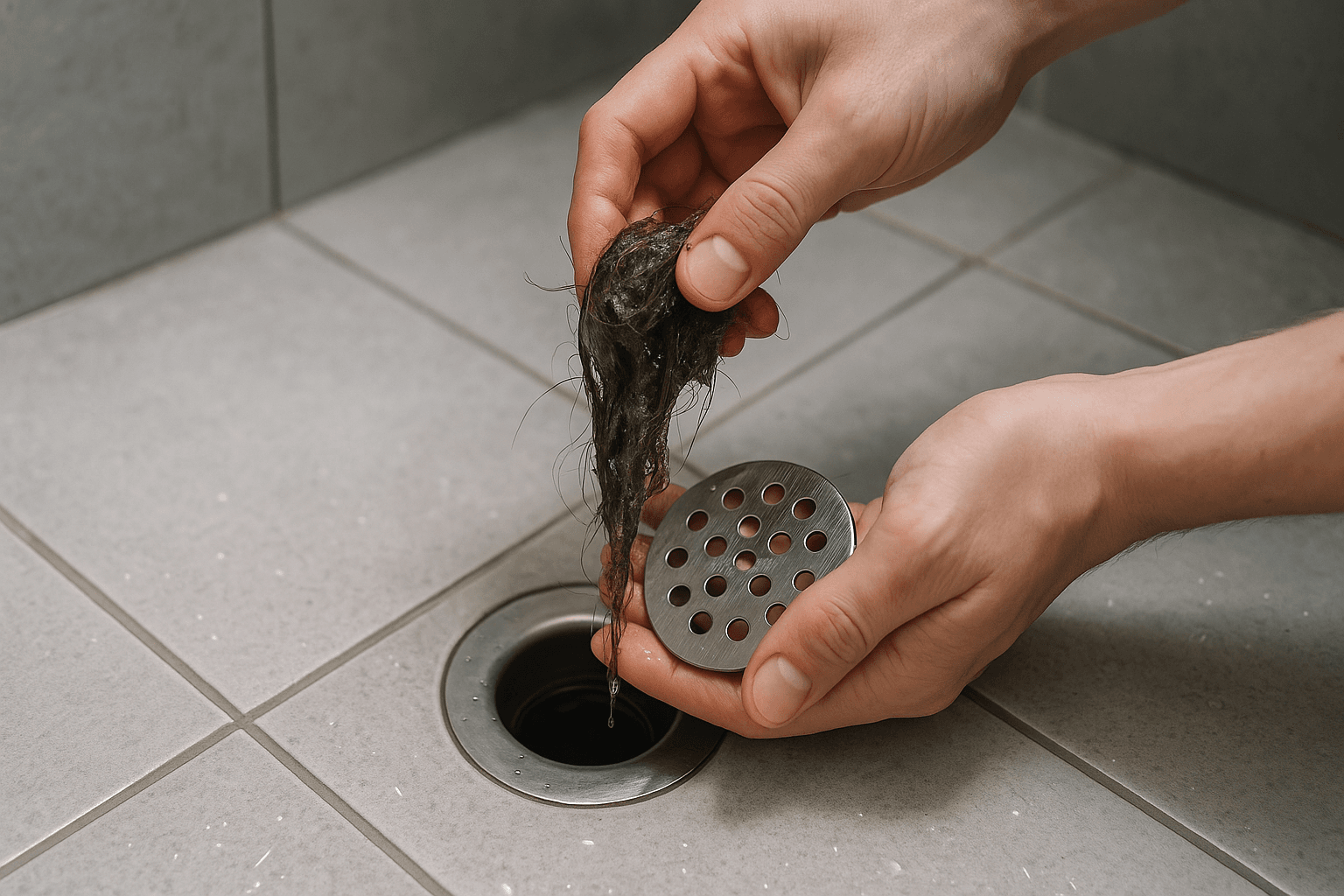
Let’s be real for a second. We know what’s causing the blockage. It’s usually a nasty cocktail of long hair, soap scum, and dead skin cells. In Gilbert, we have the added “bonus” of hard water deposits—calcium and magnesium that cling to the inside of your pipes like cholesterol in an artery.
When that water slows down, the soap scum hardens. Then, a few strands of hair get caught on the rough edges of the scum. Then more hair catches on that hair. Before you know it, you’ve got a biological net catching everything that tries to pass through. It’s gross, but understanding the enemy is half the battle.
Here is a quick breakdown of what you might need before we get started:
| Tool | Purpose | “Gross Factor” |
|---|---|---|
| Wire Hanger | Fishing out hair clumps near the surface | High |
| Cup Plunger | Forcing the clog to move via pressure | Low |
| Baking Soda & Vinegar | Dissolving grease and soap scum naturally | None |
| Plumbing Snake | Reaching deeper blockages | Medium |
The “MacGyver” Move: The Wire Hanger Trick
If you don’t have a fancy plumbing snake, don’t worry. You can make one. This is honestly the most effective first step because, nine times out of ten, the clog is sitting right at the top of the drain, just under the grate.
Go check your closet for a wire coat hanger. Straighten it out as best as you can, but leave a small hook at the end—think of a shepherd’s crook, but tiny.
First, you need to remove the drain cover. Some of them pry off with a screwdriver, and some are screwed down. Pro tip: If there are screws, close the drain or cover the hole with a rag while you unscrew them. If you drop a screw down that pipe, you just turned a ten-minute job into a two-hour headache.
Once the cover is off, stick your hook in there. You aren’t trying to jam the clog down; you want to fish it out. Poke around, twist it a bit, and pull up. You’re going to pull up a slime-covered creature that looks like a wet rat. It’s going to smell bad. Just have a trash bag ready and try not to look too closely at it.
Plunging Isn’t Just for Toilets
If the hanger trick didn’t get everything, or if the clog is pushed further down the pipe, it’s time to apply some pressure. But here’s the thing—you can’t just use any plunger.
You want a cup plunger (the one that looks like a red half-ball), not a flange plunger (the one with the extra flap that’s meant for toilets).
For a shower drain to clear properly, you need a vacuum seal. If you have a shower-tub combo, this is tricky because there is usually an overflow drain—that little metal circle higher up on the tub wall. If you start plunging the bottom drain, the air pressure will just shoot out the overflow hole instead of pushing the clog.
So, get a wet rag or some duct tape and seal off that overflow drain tight.
Now, run enough water into the shower to cover the lip of the plunger cup. Place the plunger over the drain, get a good seal, and pump it vigorously. You aren’t just pushing; the pulling motion is actually more important because it can loosen the debris and bring it back up to where you can grab it. Do this for about 20 seconds. If the water drains with a satisfying whoosh, you’re golden.
The Science Fair Experiment (Baking Soda & Vinegar)
Sometimes the problem isn’t a solid mass of hair. Sometimes, it’s just a thick layer of sludge and soap scum narrowing the pipe. If the water is draining slowly but not completely stopped, this is a great maintenance trick.
Pour about a cup of baking soda down the drain. Let it sit for a minute. Then, pour a cup of white vinegar down after it.
Remember making volcanoes in elementary school? That’s exactly what’s happening in your pipes. The fizzing reaction expands and eats away at the grime clinging to the pipe walls. It’s pretty satisfying to listen to.
Cover the drain with a wet rag to keep the fizzing action directed downward. Let it sit for about 15 to 30 minutes. While you wait, boil a kettle of water.
Flush the mixture with the boiling water. However, a quick note on this: if you have PVC pipes (white plastic), boiling water can sometimes soften the glue at the joints if used excessively. Hot tap water is safer for plastic pipes, but boiling is usually fine for older metal pipes.
Getting Serious with a Plumbing Snake
Okay, so the hanger failed, the plunger didn’t work, and the volcano experiment was a bust. The clog is stubborn. It’s dug in deep. It’s time to break out the hardware.
You can buy a manual drain snake (also called a hand auger) at any hardware store in Gilbert for about twenty bucks. It’s basically a long, flexible metal cable coiled inside a drum.
Here is how you use it without making a mess:
- Feed the cable into the drain by hand until you hit resistance. That’s the clog (or a bend in the pipe).
- Tighten the lock on the snake so the cable doesn’t slide back in.
- Crank the handle clockwise. This spins the tip of the cable, drilling it into the blockage.
- If it feels stuck, that’s actually good. You’ve hooked the monster.
- Pull the cable back out slowly.
You might have to do this a few times. It’s a bit of a workout, and again, what comes out of that drain is going to be unpleasant. But seeing that water swirl down the drain instantly afterwards? That feeling is pure victory.
A Quick Word on “Liquid Fire” and Harsh Chemicals
You might be tempted to just pour a bottle of heavy-duty chemical cleaner down there. The bottle promises to dissolve anything in minutes. It seems like the easy way out, doesn’t it?
Please, proceed with caution.
Those chemical cleaners work by creating heat. They are caustic. If you have older pipes, or if the chemical doesn’t clear the clog and just sits there eating away at the pipe walls, you could end up with a leak. A leak is a much, much more expensive problem than a clog. Plus, they are terrible for the environment. If you can avoid them, your plumbing (and the local water treatment plant) will thank you.
Why Does This Keep Happening in Gilbert?
You might be thinking, “I just cleaned this six months ago!”
Well, living in the desert has its quirks. Our water in Gilbert is notoriously hard. That high mineral content creates scale buildup on the inside of your pipes faster than in other parts of the country. That scale creates a rough surface, which makes it way easier for hair and soap to snag and start forming a new clog.
If you find yourself battling drains constantly, you might want to look into a water softener if you don’t have one. But the cheapest prevention? A hair catcher. It’s a little mesh screen that sits over your drain. It costs five dollars, and it saves you hours of work. You just wipe it off after every shower. Simple.
When the DIY Magic Runs Out
Look, we love a good DIY victory. There is something satisfying about fixing your own house. But sometimes, a clog is more than just a clog.
If you’ve snaked the drain and the water still backs up, or—and this is the big one—if when you flush the toilet, water bubbles up in the shower? Stop what you are doing.
That is not a shower drain issue; that is a main Sewer Line issue. The blockage is deep in the system, possibly out in the yard where tree roots might have crushed a pipe. No amount of vinegar or hand-cranking is going to fix that. In fact, running more water will just cause a backup that could damage your flooring.
At that point, you need professional equipment. We’re talking motorized augers, hydro-jetters, and sewer cameras to see exactly what is going on.
Let Us Handle the Dirty Work
You’ve got better things to do than wrestle with a slimy drain or worry about whether you’re about to flood the bathroom. If you’ve tried the basics and the water is still rising, or if you just don’t want to deal with the “gross factor” (we don’t blame you), give us a shout.
We’ve seen it all, and we have the tools to clear that drain quickly so you can get back to enjoying your morning routine.