Walking across your kitchen floor in socks shouldn’t feel like stepping onto a heated driveway in the middle of July. If you’ve noticed a random warm spot on your tile or hardwood, your stomach might drop a little—and honestly, it should. That warmth is often the first subtle whisper of a much louder problem happening right beneath your feet. We’re talking about slab leaks, the quiet destroyers of Gilbert homes. It’s a plumbing issue that sounds terrifying, primarily because you can’t see it, but understanding what’s happening under that concrete is the first step to fixing it without losing your mind.
So, What Exactly is a Slab Leak?
Let’s strip away the fancy plumber jargon for a second. Most homes here in Gilbert, especially those built in the last twenty or thirty years, sit on a concrete foundation known as a “slab.” Buried deep inside or directly underneath that concrete are the copper water lines that supply your faucets, showers, and toilets.
A slab leak happens when one of those copper pipes fails. It develops a pinhole leak, a crack, or a rupture, and starts spewing water into the soil or into the concrete itself.
Think of it like a bruise under your skin. You might see the discoloration or feel the swelling on the surface, but the actual injury is buried deep down where you can’t touch it. Because the water has nowhere to go, it starts pressing upward against the foundation. It’s not just a puddle; it’s hydraulic pressure. Over time, that pressure can crack your tile, warp your wood floors, and even shift the foundation of the house itself.
The “Tell-Tale Heart” of Plumbing Problems
You know how in that Edgar Allan Poe story, the narrator hears a heartbeat that isn’t really there? Slab leaks can feel a bit like that. You might hear water running when the house is dead silent, even though every faucet is turned off tight. It’s maddening.
But aside from the phantom sounds, there are physical signs you shouldn’t ignore. Since the leak is hidden, you have to play detective. Here is a quick breakdown of what to look for:
| Symptom | What It Looks/Feels Like | Why It Happens |
|---|---|---|
| Hot Spots | A specific area of the floor feels warm or hot to the touch. | Hot water lines are leaking, heating up the concrete slab. |
| Sky-High Bills | Your water bill jumps significantly without a change in usage. | The water is running 24/7 underground, racking up costs. |
| Damp Flooring | Carpet feels wet, or hardwood starts to buckle and warp. | Water is seeping up through the porous concrete. |
| Low Pressure | The shower feels weak or the sink takes forever to fill. | Water is escaping into the ground before it reaches the tap. |
| Cracked Baseboards | Visible cracks in walls or baseboards near the floor. | The foundation is shifting due to water saturation. |
If you notice mold popping up near the floorboards, that’s another red flag. Mold loves a consistent water source, and a slab leak is basically an all-you-can-drink buffet for fungus.
Why Does This Happen in Gilbert?
It’s easy to feel like you just got unlucky, but there’s actually a bit of science—and geography—at play here. Gilbert isn’t exactly kind to copper pipes.
First off, we have hard water. The mineral content in Arizona water is notoriously high. Over time, those minerals rush through your copper pipes and create turbulence. It acts almost like sandpaper on the inside of the pipe, slowly wearing down the metal until it becomes paper-thin. Eventually? Pop. You get a pinhole leak.
Then there’s the soil. We live on expansive clay soil. When it rains (on those rare occasions), the ground swells. When it dries out, the ground shrinks. This constant shifting puts immense pressure on your foundation and the pipes underneath it. It’s like bending a paperclip back and forth; eventually, the metal fatigues and snaps.
Also, just the age of the home matters. If your house was built during the construction boom of the 90s or early 2000s, your copper pipes are hitting that 20-25 year mark where corrosion starts winning the battle. It’s simply the lifecycle of the material in this environment.
How We Find the Leak Without Wrecking Your House
This is the part that scares homeowners the most. You might be picturing a crew showing up with jackhammers and tearing your living room apart just to find the leak.
Relax. That’s the old way.
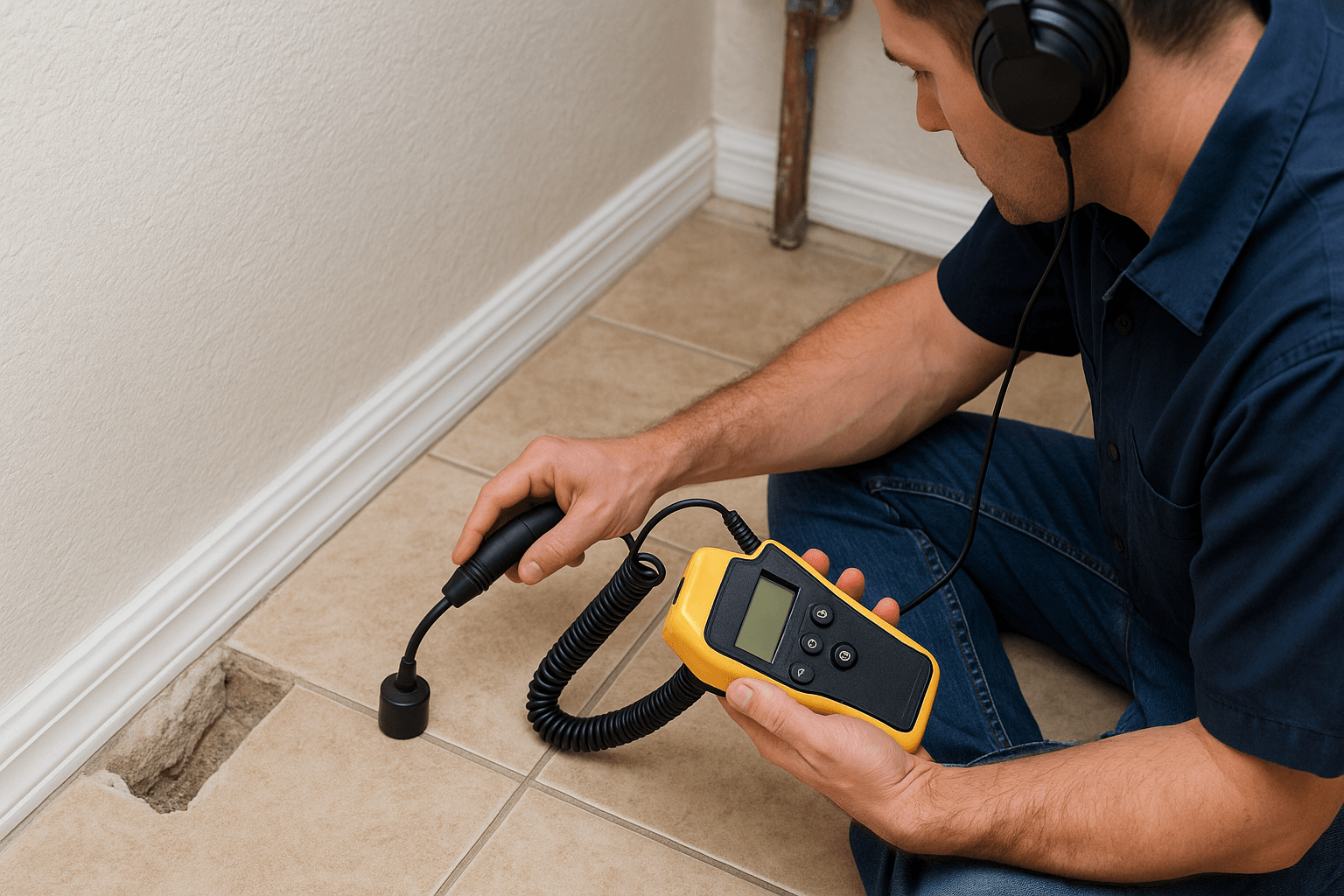
Modern slab Leak Detection is remarkably non-invasive. We use specialized equipment to pinpoint the issue before we ever think about picking up a shovel. It’s a mix of art and science.
Electronic Listening
We use high-frequency acoustic equipment. It looks a bit like a doctor’s stethoscope connected to a high-tech headset. Leaking water makes a specific frequency sound as it escapes the pipe—a sound the human ear can’t usually hear through concrete. Our technicians are trained to listen for that specific “hiss” or “whoosh.”
Line Tracing
We need to know exactly where the pipes run. We use electromagnetic pipe locators to map out the system under your floor. This helps us avoid false positives.
Pressure Testing
By isolating different parts of your plumbing system and pressurizing them, we can determine if the leak is on the hot side or the cold side. This narrows down the search area significantly.
Here’s the thing—detecting the leak is arguably the most skilled part of the job. If a plumber guesses wrong, they’re digging a hole in your floor for no reason. You want someone who measures twice (or ten times) and cuts once.
Okay, You Found It. Now How Do We Fix It?
Once we know where the leak is, we have to decide how to handle it. And you usually have options. It’s not always a “one size fits all” situation.
Option 1: The Direct Repair (Spot Repair)
This is exactly what it sounds like. We open up the concrete right at the spot of the leak, cut out the bad section of pipe, and replace it.
- Pros: It fixes the immediate problem.
- Cons: It’s messy. We have to remove flooring and break concrete. Plus, if your pipes are old and corroded, fixing one spot might just cause pressure to build up and burst the pipe a few feet away next month. It’s a bit like patching an old pair of jeans; the fabric around the patch is still weak.
Option 2: The Re-Route (Usually Recommended)
Instead of digging into the floor, we abandon the leaking pipe underground. We leave it there (it’s dead, it can’t hurt anyone). Then, we run a brand new PEX line through your walls or attic to replace the function of that broken pipe.
- Pros: No jackhammering inside the house. You get a brand new pipe that won’t corrode like copper. It’s cleaner and often faster.
- Cons: We might have to cut some drywall, but patching drywall is way cheaper and easier than matching tile or hardwood flooring.
Option 3: Pipe Lining
In some rare cases, we can shoot an epoxy coating into the pipe to seal the leak from the inside. It’s high-tech, but it’s not always suitable for every situation, specifically if the pipe has collapsed or is too far gone.
A Quick Note on Insurance
This is the million-dollar question: Does insurance cover this?
Obviously, every policy is different, and we aren’t insurance adjusters. However, generally speaking, most homeowners’ insurance policies in Arizona cover the “access” to the leak and the “resulting damage.”
What does that mean? well, they usually won’t pay for the $50 piece of copper pipe that broke (that’s considered maintenance/wear and tear). But they often cover the cost of tearing up the floor to get to it, and fixing the water damage to your cabinets or flooring. The detection and the re-route work are often part of the claim discussion. It’s always worth calling your agent immediately.
Don’t Wait Until Your Living Room Floods
Look, nobody wakes up on a Tuesday excited to call a plumber about a foundation issue. We get it. It’s stressful, and it feels like an invasion of your sanctuary. But ignoring a potential slab leak is the most expensive decision you can make. A small leak today is a cracked foundation tomorrow.
If you hear water running, feel a hot spot, or just have a gut feeling that something isn’t right with your Gilbert home’s plumbing, you need to act fast. We have the tools to find it and the experience to fix it without turning your life upside down.
Let’s get your home back to being dry, solid, and safe.